Home/Services/Contract BDM Service
A business development manager on contract, judged on a scorecard you can see.
We read your market every working day, find the jobs forming before they are let, name the person who plans each one, start the conversation in your name and book the meeting into your calendar. You step in once a meeting is booked. The quote and the close stay yours.

The same service in a marina, on a cleaning run and in a fabrication shop, across Australia
Part one of a two part sales journey.
Every job a service business wins travels the same road. Someone finds it, someone opens the conversation, someone confirms it is real, then someone quotes it and closes it. We take the first half of that road and hand you the second, with the meeting already in your calendar.
Read the market, find the job, name the person who plans it, open the conversation in your name, ask the questions that confirm the fit, and book the meeting straight into your calendar with the notes attached.
The meeting itself, the site visit, the quote, the follow up and the close. This stays with you, because nobody quotes your work the way you do.
Work arrives through referrals, repeat clients and the odd tender, so growth depends on who happens to call. A site that has just opened or changed hands chooses its supplier once and rarely revisits it.
Every job in motion is found as it moves. The decision maker is named, a message written for them lands with a follow up behind it, and the reply is answered the same day.
Businesses that already have a salesperson doing this, businesses that sell to the public, and markets too small to be worth it.
How the work runs
Every working day, from your market to your calendar. Nothing is written until the job is real and the person is named, and nothing is sent until you have approved it.
1. Find and filter
The market is read every working day. Tender and procurement portals, approvals and project registers, local and industry news, company announcements and hiring signals. Every job is checked by a person against your brief, and a job that does not pass is left out, however big it looks.
2. Name the person who decides
The person who plans or lets the work, with their role and direct details where published, checked before any approach. Never a generic inbox.
3. Write and follow up, in your name
A message written for that person about that job, in your voice, referencing the signal and why you fit it. A follow up behind every message, every reply answered, usually the same day, and the not now replies kept warm with a recheck date.
4. Book the meeting
Once the job, scope and timing are real, a meeting lands in your calendar with the notes attached, ready for you to quote.

Considered, not blasted.
The opposite of a bought list and a bulk send. A handful of researched approaches a week, each to a named person about a real job, is what earns replies from people who normally ignore cold contact. It is also what protects a reputation that took years to build.

What is learned is kept.
Everything is recorded. Which signal produced the job, which message earned the reply, which approach led to the meeting. Over the thirty days the brief sharpens, the sources are refined and effort moves to what is working. By day thirty you hold a clear read on where your next contracts come from, not only the contracts themselves.

Your job tracker, live from day one.
Every job, its source, the person who decides and the next move in one place, open on a phone or a laptop at any hour. It updates every working day, nothing on it is hidden from you, and it is yours whether you continue or not.
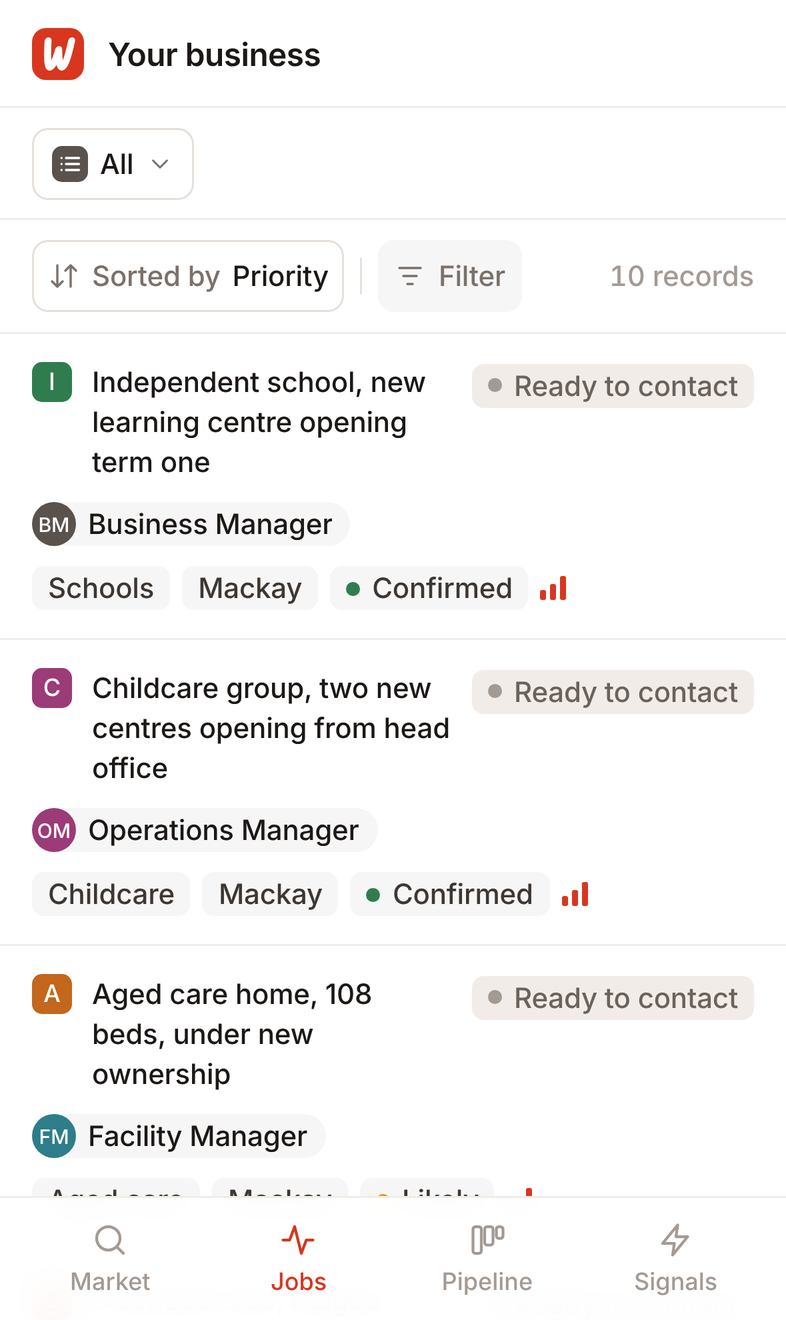
Four pages, and what every job carries.
Everything on the tracker is written so you can rule a job in or out before anyone picks up the phone.
The size of your market, the kinds of site that fit, what makes a best lead, the signals that mean now, the timing calendar and where the leads are sourced.
Every job today, each with the signal, the decision maker, why it fits, what working together looks like and the next move.
New buildings handing over, new owners and managers, stage handovers, tenders and panels, openings and moves, each with the window to act.
Where every conversation sits, from first approach to meeting booked, with the contract outlook, the likely term and the introductions each job could open.
The signal and its date with a link to the source, the decision maker, the fit and its priority, the contract outlook, and the next move with a timeline of every approach, reply and call.

The thirty day pilot
Two weeks of set up, thirty days of work, one clear decision.
Accept
Set up, about two weeks
Day one
Days one to thirty
Day thirty
Who does what
The split of the work, so nothing falls between us and nothing is done twice.
The job tracker, the decision maker named for every job, a message written for each person in your name, the follow ups, every reply answered, meetings booked with the notes attached, the sending accounts and every tool, a weekly call and a short written report.
A short brief at kickoff, your no go list, the facts to reference in your name, the inbox that receives replies and the calendar that receives meetings, and approval of the first messages, usually within a day.
You. Nothing goes out in your name until you have approved it, and you can see every message on the tracker afterwards.
About an hour a week once set up is done. Thirty minutes on the weekly call, a few minutes approving anything new, and the meetings themselves.
A set number of replies, meetings or contracts. What is promised is the work, every working day, against a scorecard you can see.
How the pilot is judged
Three measures, fixed now. The targets are agreed with you at kickoff, recorded on your tracker and reported against every week, so there is never a question about what the pilot is being judged on.
A reply or a call back from the person who plans or lets the work. Target agreed at kickoff.
A meeting in your calendar with that person, where the job, scope and timing are confirmed. Target agreed at kickoff.
A quote you send following a meeting booked through the pilot. Target agreed at kickoff.
Businesses found, decision makers named, approaches made and first year contract value in conversation, with your own job values logged against each.
Every job on the tracker approached and followed up, a handful in live conversation, a few meetings in your calendar with the notes attached, and a clear read on which signals and messages work in your market.
Your name is the asset.
Every rule protects it. The first message a decision maker reads from you is written to your standard, and nothing goes out until you have approved it.
Your criteria first
The right person
Your name, your voice
Quality over volume
Qualified meetings only
Your main domain is never touched
Your no go list respected
Conflicts and crossover
Standards
What you keep.
- The tracker. Every job and decision maker on it, every conversation and every warm prospect, during the pilot and after it, whether you continue or not.
- Your materials. Everything you supply stays yours and is used only to run the pilot.
- The accounts. The sending accounts set up for you are transferred at no charge if you continue or ask for them.
- Your data. Handled reasonably, kept secure and used only to deliver the pilot. On request we delete our working copy once the handover is complete.
What stays with us is the method. Research sources, message structures, sequencing and tools remain confidential. You receive the results.

One fixed fee, then your decision.
Simple pricing in Australian dollars, with no lock in and nothing added unless you ask for work outside the scope.
The Thirty Day Pilot, $3,500
Paid on acceptance, covering set up and thirty days of business development. The tracker, the research, the approaches in your name, every reply handled, the meetings booked, the weekly call and report, the day thirty handover, and every account and tool used to run it. No hourly billing.
To walk away at day thirty
Nothing further. You keep the tracker, every conversation and every warm prospect, and the sending accounts if you want them.
After day thirty
Continue month to month, or stop. The arrangement after day thirty is set out in the service document you receive after the free call, and it is agreed in writing before day one.
Results so far
Figures across recent Win Work campaigns, presented as one combined picture. The published averages are from a 2026 industry benchmark of cold business outreach.
79% across recent campaigns, against a published average of about 44%.
5% across recent campaigns, against a published average of about 3.4%.
On a recent pilot, a commercial cleaning business in NSW was quoting in week one and had about $180k of pipeline by the end of its first month.
Owners we have done this for are happy to take a call. Ask on the free call and their details are sent on request.
Questions owners ask.
The questions that come up on nearly every call, answered the way they are answered on the call.
Why a fee at all? Why not commission from day one?
What exactly does $3,500 buy?
Are results guaranteed?
How many meetings can realistically be booked in a month?
We tried cold outreach before and only got rejections. How is this different?
Half the sample list are already our customers. Is that a problem?
Do the approaches come from our domain? Will they land in spam?
What access do you need from us?
Who answers the replies, and do you attend the meeting?
What if you work with one of our competitors?
How much of our time does it take?
What if something breaks or goes wrong?
Can the target market widen later?
Can we speak to someone you have done this for?
How soon can we start?
Next step
Book a free call and see a real tracker. If you would like to know whether your market is big enough first, the market size check answers that in two minutes.
Thirty days is enough to know.
Book a free call, tell us what you do and where, and see a real tracker before you decide anything.
